
SaaS Marketing Funnel Strategy | 11 Steps to Turn Visitors Into Paying Customers
More than 30,000 SaaS companies now compete for the same buyer attention. Most still pour their budget into ads and overlook a channel that keeps paying back long after the campaign ends. A SaaS marketing funnel turns that pattern around. It gives a stranger a reason to trust your brand. It guides them through research, and it nudges them toward a trial or a paid plan, all without a fresh ad spend for every new visitor.
This guide rebuilds that idea from the ground up. It covers every funnel stage, lays out 11 practical steps, and points to real SaaS brands doing this well right now. Want the wider view first? Our SaaS SEO and digital marketing strategy guide is the pillar post this article supports.
Maybe you run a two-person startup. Maybe you run a growth-stage SaaS company with a full marketing bench. Either way, the framework below helps you pull in the right visitors, move them toward a free trial, and keep them as paying customers long after signup.
Table of Contents
- What Is SaaS Content Marketing?
- What Is a SaaS Marketing Funnel?
- Top of the Funnel in SaaS: Where Awareness Starts
- Real SaaS Funnel Examples Worth Copying
- Sales Funnel vs Marketing Funnel: The Real Difference
- Why Funnel-Stage Content Pays Off for SaaS Companies
- 11 Steps to Build a SaaS Marketing Funnel
- How to Turn SaaS Content Into Leads and Paying Customers
- SaaS Content Marketing Stats Worth Knowing in 2026
- Frequently Asked Questions
- Conclusion: A Funnel That Keeps Working After You Log
- About the Author
1. What Is SaaS Content Marketing?
SaaS content marketing is the continuous work of creating, publishing, and refining content. It attracts your ideal buyer, teaches them, and eventually converts them, largely without leaning on paid ads to do the heavy lifting.
SaaS products differ from a one-time purchase. A buyer subscribes, cancels, or renews based on trust, and that trust builds over weeks or months, not with one impulse click. Content plays a bigger role here than in most e-commerce categories. It closes the gap between the problem a prospect is dealing with and the product that solves it.
The Content Marketing Institute’s 2025 B2B report found something telling. A large majority of the strongest-performing B2B marketers worked from a written, documented strategy, while only a small share of the weakest performers did the same. A plan on paper consistently beats a pile of random posts.
A working SaaS content strategy usually blends several formats: blog articles, comparison pages, use-case guides, product walkthroughs, webinars, email sequences, and small interactive tools. Each format earns its place by doing a specific job somewhere in the funnel.
In practice, content marketing for SaaS works because it teaches before it sells. A reader gets a real answer first. The product only comes up once trust has already been earned.
2. What Is a SaaS Marketing Funnel?
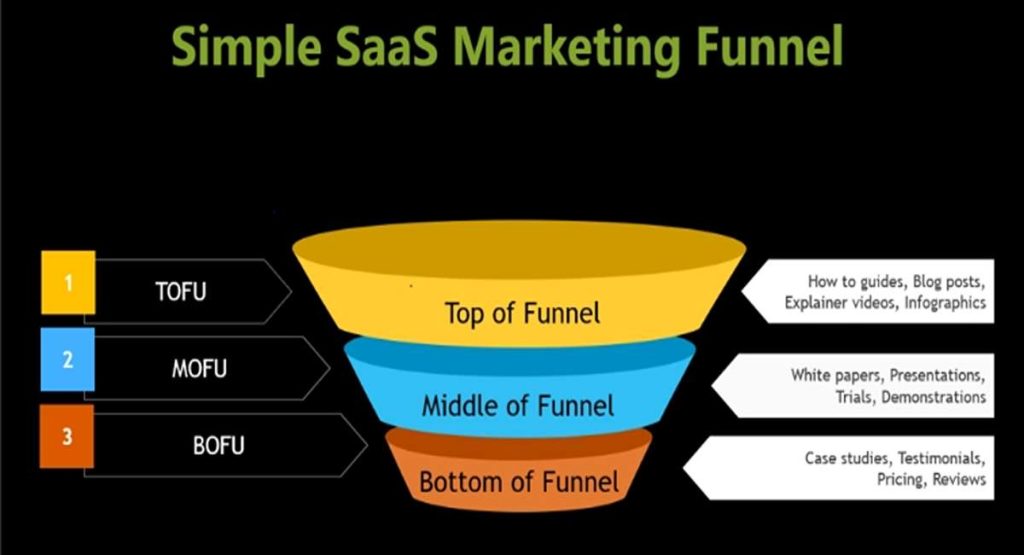
The SaaS marketing funnel maps every stage a buyer moves through. It starts the first time they hear your name and ends the day they become a paying, renewing customer. That path rarely runs in a straight line. Most buyers touch several channels, over several weeks, before they decide anything.
Stage | Name | What It Does |
TOFU | Awareness | Builds visibility through SEO blogs, social posts, podcasts, and video |
MOFU | Consideration | Builds trust through comparisons, case studies, webinars, and email nurture |
BOFU | Decision | Drives conversion through free trials, demos, ROI calculators, and pricing pages |
Post-Funnel | Retention and advocacy | Cuts churn and earns referrals through onboarding content and loyalty programs |
Forrester’s 2025 research found something worth noting. SaaS companies with content built for all four stages report roughly 2.5 times higher customer lifetime value than companies that only invest in top-of-funnel awareness.
SEO SaaS work touches every stage of this funnel. It is the engine that keeps each piece of content discoverable. That holds true whether a reader is at the awareness stage or ready to sign up. At its core, this is really a B2B SEO marketing funnel question: organic search carries a stranger through every stage without another ad click. For a deeper look at how organic search supports the whole journey, read our post on the role SEO plays in a SaaS content strategy.
3. Top of the Funnel in SaaS | Where Awareness Starts
TOFU content, short for top of the funnel, is where your SaaS brand first becomes visible. At this point, people who do not yet know your product exists are searching for a problem, not a product.
A project manager typing “how to reduce team miscommunication” is not ready to buy software yet. Your job here is to show up with something genuinely useful and earn trust before you ever mention your product.
Content Formats That Work Well at TOFU
- SEO blog posts — written around informational, problem-aware search terms with decent volume and manageable competition.
- Video and short-form clips — quick tutorials that solve one specific problem and support brand discovery.
- Podcast guest spots and interviews — thought-leadership content that reaches audiences outside your own list.
- Infographics and visual guides — shareable assets that pick up backlinks and social shares.
- Free tools and calculators — interactive TOFU assets, such as an ROI calculator, with strong conversion intent.
- Social content — LinkedIn posts, X threads, and active participation on Reddit that build a visible presence.
Semrush’s State of Content Marketing 2025 study found that more than half of marketers still name blog posts as their top TOFU tactic for SaaS lead generation. That said, the bar has moved. Search engines, including AI-driven ones, now reward depth over sheer output.
Three thin, 500-word posts a week will not rank well in 2026. One well-researched, 2,000-plus-word guide that actually answers the question will consistently outperform them. Solid keyword research is what separates a guide that ranks from one that does not. Our guide on how to conduct keyword research for SaaS content walks through the process.
4. Real SaaS Funnel Examples Worth Copying
Looking at how established SaaS brands built their funnels gives you a working blueprint rather than a guess. Here are three approaches worth studying.
HubSpot | A Full-Funnel Content Engine
HubSpot pulls in over 7 million organic visitors a month using a layered content system. Free blog posts cover TOFU. Downloadable templates and certification courses handle MOFU. A free CRM trial paired with personalised demos closes out BOFU. The whole system runs on self-serve, content-led discovery.
Ahrefs | A Bottom-Up, Product-Led Funnel
Ahrefs built a customer base of more than 100,000 almost entirely through content. Nearly every article points back to its own tool as the fix. Keyword research tutorials cover TOFU. Case studies showing traffic gains handle MOFU. A free version of Ahrefs Webmaster Tools works as the BOFU entry point.
Notion | Community-Led Awareness
Notion leans on user-made templates and community content for its TOFU reach. A library of more than 2 million templates acts as a discovery engine on its own. Each template drops a new user straight into the product, skipping the traditional blog-to-signup path entirely.
The pattern across all three is simple: every piece of content gives the reader a clear next step, whether that is a free trial, a download, or a demo request.
5. Sales Funnel vs Marketing Funnel | The Real Difference
A lot of SaaS founders blend the sales funnel and the marketing funnel together. That mix-up usually costs them alignment, budget, and results.
Dimension | Marketing Funnel | Sales Funnel |
Owned by | Marketing team | Sales team |
Main goal | Generate and nurture leads | Close deals |
Content type | Blogs, video, webinars, SEO | Demos, proposals, calls |
Key metrics | Traffic, MQLs, engagement | SQLs, pipeline, revenue |
Funnel stage | Awareness to consideration | Decision to close |
SaaS example | Blog post leads to an email signup | Demo call leads to a paid plan |
In the SaaS companies that get this right, both funnels meet at the MQL-to-SQL handoff. Marketing nurtures a lead with content until they look sales-ready, then hands them off for a personal follow-up. This is also where a strong SaaS inbound marketing motion pays off, since inbound content feeds that handoff in the first place. Our guide on SaaS inbound marketing breaks this down further.
6. Why Funnel-Stage Content Pays Off for SaaS Companies
Understanding funnel stages is not just theory. Building content on purpose for each stage produces measurable results.
TOFU: Visibility and Brand Authority
Top-of-funnel content puts your brand in front of thousands of people who have never heard of you. One well-optimised TOFU post can pull in organic visitors for years without another cent of ad spend. HubSpot’s 2025 marketing report backs this up: companies that publish consistently generate roughly two-thirds more monthly leads than companies that do not publish at all.
MOFU: Trust and Qualification
Detailed case studies, comparison pages, and email nurture sequences keep your brand front of mind. That matters most during a buyer’s typical two-to-four-week research window. This is where a curious visitor turns into a genuinely qualified lead.
BOFU: Conversion and Revenue
Bottom-of-funnel content clears away the last objections standing between a visitor and a signup. Free trials, ROI calculators, live demos, and testimonial-heavy landing pages can lift trial-to-paid conversion by 25 to 40 percent. That figure comes from Totango’s 2025 SaaS benchmark.
Post-Funnel: Retention and Advocacy
Bain & Company puts the cost of winning a new SaaS customer at 5 to 7 times the cost of keeping an existing one. Post-funnel content changes that math. Onboarding guides, feature-update emails, and customer stories cut churn and turn quiet users into vocal advocates.
7. 11 Steps to Build a SaaS Marketing Funnel
A strong SaaS marketing funnel does not happen by luck. These are the 11 steps that fast-growing SaaS brands follow in 2026.
Step 1: Define Your Ideal Customer Profile
Know exactly who you are writing for before you write anything. Build detailed buyer personas around job title, pain points, goals, and the tools they already use. Every content decision should trace back to this profile.
Step 2: Map Content to Each Funnel Stage
Audit what you already have and find the gaps. Is there enough TOFU awareness content? Do MOFU comparison pages exist? Does BOFU content push clearly toward a trial or demo? This is arguably the most important step on the list. Skip funnel mapping, and you end up with traffic that never turns into revenue.
Step 3: Run Deep Keyword Research
Use a tool such as Ahrefs, Semrush, or Google Search Console to surface high-intent keywords at every stage of the funnel. Favour problem-aware terms for TOFU and product-aware terms for BOFU. Our full walkthrough on SaaS keyword research covers the tools and the process in detail.
Step 4: Build a Content Calendar and Stick to It
Consistency beats raw frequency every time. Two well-researched, 2,000-word posts a month will out-rank five rushed 400-word posts. Plan the calendar at least 90 days out so nothing gets written under pressure.
Step 5: Invest in Long-Form Cornerstone Content
Produce three to five pillar articles each quarter. These should be comprehensive, research-backed guides built around your most important keywords. They become the backbone that carries your organic traffic over time.
Step 6: Build a Strong Internal Linking Structure
Connect TOFU, MOFU, and BOFU content with deliberate internal links. Every post should hand the reader a logical next step, whether that is a related guide, a case study, or a free-trial page. A healthy link structure also supports the technical side of SEO. See our technical SEO for SaaS guide for the fundamentals, and our post on link-building tactics for SaaS for earning links from outside your own site.
Step 7: Build a Lead Magnet Library
Create downloadable assets, such as templates, checklists, and toolkits, tied to your best-performing content. These turn casual readers into email subscribers you can nurture over time. Before you build this library, read our breakdown of common content marketing mistakes SaaS startups make. A weak lead magnet at this step wastes traffic you already earned.
Step 8: Design an Email Nurture Sequence
Once a reader subscribes, walk them through a 5-to-7-email sequence that teaches, builds trust, and points toward a trial or demo. Campaign Monitor’s 2025 data shows that personalised emails lift open rates by up to 29 percent.
Step 9: Create Product-Led Content at BOFU
Show your software doing real work inside your content: screenshots, short clips, product walkthroughs. BOFU content that demonstrates the product outperforms generic blog writing by a wide margin. At this decision stage, buyers weigh vendor credibility as much as features. Showcasing your SaaS industry expertise is often what separates a signed deal from a lost one.
Step 10: Measure, Adjust, and Double Down
Track performance by funnel stage using Google Analytics 4, Search Console, and your CRM together, not traffic numbers alone. Find out which content actually drives trials and revenue. Then put more resources behind what is already working, and cut what is not.
Step 11: Repurpose Content Across Channels
One long-form guide can become a LinkedIn carousel, a short video, an X thread, a podcast episode, and an email series. Repurposing multiplies your reach without multiplying your workload. Our post on content distribution strategies for early-stage SaaS covers how to plan this without burning out your team.

8. How to Turn SaaS Content Into Leads and Paying Customers
Traffic that never converts is just a vanity number. Here is how to make sure your funnel actually produces leads and revenue.
Use a Clear Call to Action at Every Stage
Every piece of content needs one obvious next step. TOFU posts: “download the free template.” MOFU pages: “see how [customer] grew 300 percent using our platform.” BOFU pages: “start your free 14-day trial, no card required.”
Gate Your Strongest MOFU Assets
Not everything needs to sit in the open. Place high-value assets, such as original research or a detailed playbook, behind a short email form. This is one of the fastest ways to build a qualified list. The Demand Gen Report 2025 found that gated MOFU content converts at two to four times the rate of ungated blog posts.
Get Free-Trial Onboarding Right
Your free trial is the single most important conversion point you have. OpenView Partners’ 2025 SaaS benchmark places the average free-to-paid conversion rate at around 11 percent. Top performers reach 20 to 25 percent with strong onboarding content. Build in-app guides, a welcome email series, and short tutorial videos that get new users to their “aha moment” inside the first 72 hours.
Lean on Social Proof Throughout the Funnel
G2 reviews, Trustpilot ratings, testimonials, and case studies all remove friction at every stage. Place a relevant customer story next to each BOFU call to action, not just on the homepage where it gets skimmed and forgotten.
Retarget Readers Who Did Not Convert Yet
Most visitors will not convert the first time they land on your site. Pixel-based retargeting lets you show tailored ads to people who already read a specific TOFU or MOFU page. A reader who finished your project management tips post is already a warm lead for a retargeted demo offer. This pairs well with a broader digital advertising strategy for SaaS.
9. SaaS Content Marketing Stats Worth Knowing in 2026
Metric | Figure | Source |
More leads than cold outreach | 7x | DemandMetric |
Successful B2B brands with a documented strategy | 72% | CMI 2025 |
Lower cost per lead vs. other channels | 62% | Demand Gen |
Trial-conversion lift from onboarding content | 25%+ | OpenView 2025 |
Content marketing share of budget, mid-market US SaaS | 12.1% | Gartner 2025 |
These numbers back up what high-growth SaaS teams already act on: a funnel-aligned content plan is not optional anymore. It remains one of the most cost-effective, durable growth channels a SaaS company can run. Gartner’s 2025 CMO spend survey found something notable here too: content marketing now takes up 12.1 percent of total marketing budgets among mid-market US SaaS companies, up from 9.3 percent in 2023.
10. Frequently Asked Questions
Q1. How long does it take to see results from a SaaS marketing funnel?
Results depend on the stage. TOFU content built around low-competition keywords can rank within 6 to 12 weeks. MOFU assets, such as case studies and comparison pages, usually start showing lead-generation impact within 3 to 6 months. Full-funnel ROI takes longer: 9 to 12 months of steady publishing before content reliably drives trials and paid signups. SaaS content behaves like a compounding asset, not a quick win.
Q2. How much content do I need at each funnel stage?
A workable split is roughly 60 percent TOFU, 25 percent MOFU, and 15 percent BOFU. Most teams over-invest in TOFU blog posts. They under-invest in MOFU comparison pages and BOFU case studies, which sit closest to revenue. Check your existing content against this split before you create anything new.
Q3. Should a bootstrapped SaaS startup invest in content marketing early?
Yes, but stay focused. Early-stage teams do better prioritising 3 to 5 high-intent BOFU keywords over broad TOFU traffic. One well-ranking “best [category] software” or “[competitor] alternative” page can drive more qualified trials than 50 general blog posts. Start narrow, prove the return, then expand upward through the funnel.
Q4. What metrics should I track at each funnel stage?
Track by stage instead of chasing vanity numbers. TOFU: organic sessions, keyword rankings, bounce rate. MOFU: lead-magnet downloads, email signups, time on page. BOFU: free-trial starts, demo requests, MQL-to-SQL rate. Retention: churn rate, NPS, and expansion revenue from existing users. Every stage needs its own benchmark.
Q5. Can product-led growth replace a traditional SaaS content funnel?
Not fully; the two work together. Product-led growth uses the product itself as the main acquisition channel, through free trials and freemium tiers. Content marketing plays a different role: it drives discovery and educates people before they ever touch the product. Companies such as Notion and Figma run both at once. Content brings people in, and the product handles conversion and retention.
6. How do I repurpose SaaS content across the funnel?
One research-heavy TOFU post can feed the whole funnel. Turn it into a LinkedIn carousel for TOFU awareness. Pull a statistic for a MOFU lead magnet. Build a BOFU case study around a customer who solved that exact problem, then reference it again in a retention-stage onboarding email. Repurposing cuts production cost while reinforcing the same message at every touchpoint.
11. Conclusion | A Funnel That Keeps Working After You Log Off
A properly built SaaS marketing funnel is one of the closest things to a compounding growth engine in digital marketing. Every article, every email sequence, and every BOFU page you optimise keeps working around the clock. It keeps working long after you have moved on to the next task.
Start with a clear ideal customer profile. Map your content against each funnel stage. Invest in long-form, research-backed pillar content. Track every touchpoint against revenue, not just traffic, and keep adjusting.
The SaaS companies winning in 2026 are not necessarily the ones spending the most on ads. They are the ones running the sharpest, most deliberate content strategy.
If you want help building or auditing a SaaS content marketing strategy, Skyline SEO works with SaaS and B2B brands on funnel-aligned content. Explore our SaaS digital marketing services, read more on SEO and content strategy for SaaS, or get in touch for a free content funnel audit.
12. About the Author
Skyline SEO Editorial Team, Skyline SEO is a Pakistan-based digital marketing agency specialising in SaaS SEO, B2B content strategy, and conversion-focused content writing for startups and growth-stage companies. We help SaaS brands in the USA, UK, and beyond build content engines that generate compounding organic growth. Read more on our blog and get in touch with skylineseo.pk.