
E E A T in SEO USA | A 2026 Guide to Google's Trust Framework

SEO keeps shifting, so staying ahead of Google’s updates matters more each year. One idea sits at the centre of almost every recent change.
That idea is E E A T in SEO. Most marketers already know E A T, short for Expertise, Authoritativeness and Trustworthiness. Google added a second E in 2022, for Experience, to judge content more fully.
This guide walks through what E E A T in SEO actually means and how it shapes rankings. It also covers what a site can do about it in practice. Real examples make the framework concrete. A checklist at the end turns theory into action a team can start today.
Understanding this concept properly is worth the effort, since it now touches almost every ranking decision Google makes. Businesses that get this right early tend to build a lasting edge. Those that ignore it often struggle to catch up once a competitor has already earned that trust.
Table of Contents
Toggle1. What Is E E A T in SEO?
E E A T stands for four separate qualities, and each one covers different ground.
- Experience. first hand, real world contact with the topic, not just book knowledge.
- Expertise. the depth of skill and credentials a writer or site holds in a given field.
- Authoritativeness. how widely a site or author is recognised as a real source in its niche.
- Trustworthiness. how accurate, honest and safe the content and the site feel to a reader.
In short, E E A T works as a broad framework Google uses to judge content quality. It matters most in fields like health, finance and law, where wrong information can cause real harm.
Clear, trustworthy copywriting becomes essential in these spaces, since a single misleading line can undo months of built authority.
2. Why Google Added the Extra E for Experience
Google’s original E A T framework rewarded expertise and authority well, but it missed something. A page could read as expert without ever showing real, lived contact with the subject. Google closed that gap in December 2022 by adding Experience to the guidelines.
Consider two kinds of searches side by side. Someone filling out a tax return generally wants an accountant with formal expertise. A shopper comparing tax software, however, often wants a real user who has actually tried the product.
Both readers want trustworthy content. They just need a different kind of proof to get there. That is exactly what the added E now accounts for.
3. How E E A T Shapes Google's Ranking Systems
Google’s ranking systems aim to match content to what a searcher actually needs. Quality signals have mattered for years. E E A T in SEO now sits at the core of how those signals get judged.
A site with a real track record of expertise and trust tends to outrank a thin competitor. That holds true even when both pages cover the exact same topic.
Google has never published the exact formula behind this. Even so, the pattern is clear across enough sites to trust it. Higher E E A T consistently correlates with stronger rankings. This is especially true once a topic touches a reader’s health, money or safety in any direct way.
That is also why two sites covering the same keyword can see very different results. The page built on real credentials and cited sources usually wins. A clean track record often beats a competing page that targets the exact same term with similar length and structure.
4. E E A T and YMYL Content
What is YMYL content, in plain terms? YMYL stands for Your Money or Your Life. It covers any topic where bad information could cause real harm. Medical advice, financial guidance and legal information all fall inside this category.
E E A T in SEO carries extra weight here. Google holds YMYL pages to a stricter standard than a casual hobby blog.
A high E E A T score signals to Google that a site counts as a credible source on its topic. As a direct result, that content shows up more often for searchers looking for real answers. It stops getting buried beneath more established competitors.
This distinction matters even more for a newer site entering a crowded YMYL space. SEO for YMYL pages, therefore, leans more heavily on proof and sourcing than SEO for a casual topic ever needs to. Google tends to apply extra scrutiny before trusting an unfamiliar domain with sensitive queries.
5. E E A T in Action | Real World Examples
Health websites
A medical information site authored by a real doctor already shows Experience and Expertise from the byline alone. Citing established medical centres or peer reviewed research then adds Authoritativeness.
Clear sourcing, honest limitations and transparent writing round out Trustworthiness. A site built this way tends to score well across the whole framework, especially with a team that writes for expertise rather than volume.
Financial advice websites
The opposite pattern shows up on a finance site written by an unqualified author. That site usually scores poorly on E E A T, and it gets worse fast when the site has no citations backing its claims.
Weak authority and thin trust signals then translate directly into weak rankings for money related searches. Google treats financial harm as a serious risk, so it applies extra scrutiny here.
News websites
Journalism depends on E E A T just as much as health or finance content does. Outlets that consistently cite sources, follow a clear ethics code and publish verifiable facts tend to rank well over time. Readers reward that consistency too, which is exactly the kind of trust signal Google tries to measure.
E-commerce and legal websites
Online stores build E E A T through different signals than a blog does. Detailed product information matters, alongside real customer reviews and clear return policies. Together, these show a shopper the site can be trusted with a purchase.
A legal information site follows a similar path to health content. It leans on named, licensed authors and precise, carefully sourced explanations, rather than generic advice copied from elsewhere.
Across all four examples, the same pattern holds. Content built around real experience, expertise, authority and trust consistently outperforms content missing one or more of those pieces. This is E E A T in SEO working exactly as Google intends it to.
6. Google E E A T Guidelines | What They Actually Say
Google publishes Search Quality Rater Guidelines that spell out what raters look for when they judge E E A T in SEO. The underlying ranking algorithm itself stays private, even so. A few core principles show up again and again across that document.
- Author credentials should be visible, including relevant licenses, qualifications or direct experience.
- Claims need real, checkable sources behind them, not vague references.
- User experience matters, covering everything from load speed to mobile display and on page structure.
- Transparency counts, so a clear privacy policy, terms of service and honest ad disclosure all help.
- Content needs regular updates, since a page that never changes starts to look neglected over time.
Following these principles consistently tends to lift a site’s E E A T over time. It also helps content hold its position through future updates. Core Web Vitals capture many of these page experience signals directly, and fixing them tends to lift both rankings and real user satisfaction at once.
7. A Practical E E A T Checklist
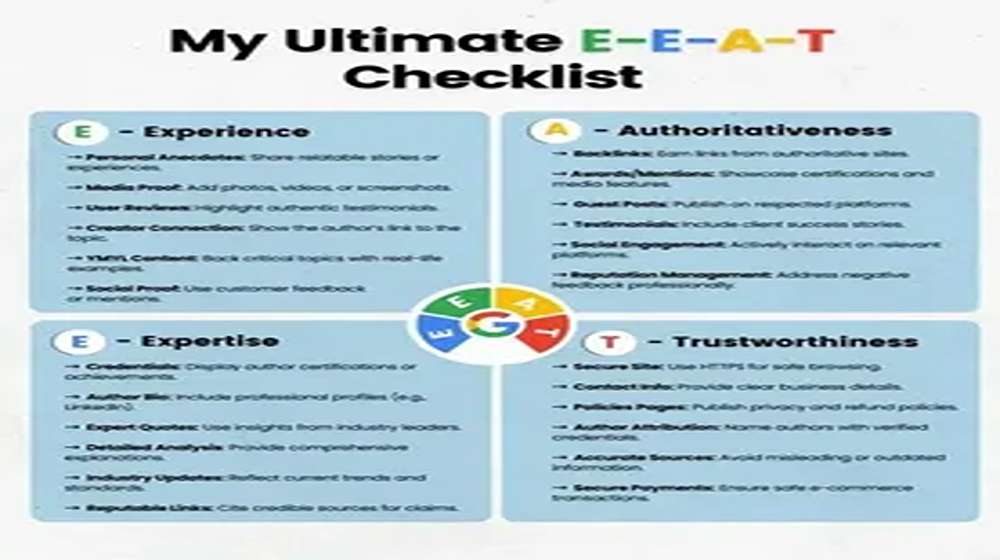
Ways to improve E E A T in SEO for better rankings now fall into five practical areas. Building E E A T is not a one time project. It works better as a standing habit across all five.
- Put real subject matter experts on the byline, and make sure content stays deep, accurate and well researched.
- Earn backlinks through outreach that earns real backlinks from sites that already hold authority in the niche.
- Publish transparent business details, including contact information, a privacy policy and clear terms.
- Fix technical SEO health issues that slow a site down or break the experience on mobile.
- Run a regular content audit, pruning or refreshing old pages so nothing stale sits on the site collecting dust.
Treating this checklist as an ongoing cycle makes the real difference here, rather than running it as a single sprint. That habit is what separates sites that hold their rankings from ones that slip back after the next update.
8. How to Measure E E A T Progress Over Time
E E A T in SEO does not come with a visible score anywhere in Google Search Console. Teams need indirect signals instead, to track real progress. A few practical measures work well in practice.
- Watch rankings on YMYL adjacent terms specifically, since these tend to move first and most visibly when E E A T signals shift.
- Track branded search volume over time, since a growing number of people searching a brand name directly often signals rising trust and recognition.
- Monitor backlink growth from genuinely relevant, authoritative sites, rather than raw link count alone, since quality matters far more than volume here.
- Review author pages and bylines periodically to confirm credentials stay current and every named contributor still has a working bio page.
None of these signals proves E E A T improved on its own. Together, though, they build a fairly clear picture. A site is either heading in the right direction, or standing still while competitors improve.
9. E E A T and AI Search in 2026
AI Overviews now appear across a large share of Google searches. The same core ranking systems decide which sources get cited inside them. A 2026 analysis of AI Overview citations, covering 36 million examples, found a clear pattern.
AI consistently favours sources that demonstrate strong E E A T in SEO, through clear credibility and topical authority.
This means E E A T now shapes more than a blue link position on a results page. It also shapes whether a brand gets quoted directly inside an AI generated answer. A site with weak trust signals risks losing visibility in both places at once. The same underlying quality signals feed both systems.
This shift raises the stakes for smaller sites in particular. A site that once ranked reasonably well through sheer keyword coverage now competes on credibility too.
An AI system summarising a topic picks a small handful of sources to quote, rather than listing every page that ranks. Building genuine authority, therefore, matters more now than it did even two years ago.

10. Common E E A T Mistakes to Avoid
- Publishing anonymous content with no named author or visible credentials, which leaves a reader with no way to judge who actually wrote the piece.
- Making claims without linking to a real, checkable source behind them, since an unverifiable claim reads as a guess rather than a fact.
- Leaving outdated statistics or advice live long after they stop being accurate, which quietly erodes trust even when nobody complains directly.
- Hiding affiliate links or sponsored content instead of disclosing them clearly, a shortcut that damages trust the moment a reader notices it.
- Treating E E A T as a one off audit instead of an ongoing part of the content process, so gains made this quarter quietly fade by next year.
Avoiding these mistakes costs far less effort than fixing them after a ranking drop. It pays to build good habits from the start, rather than reacting later.
11. How E E A T Fits Into a Wider SEO Strategy
E E A T in SEO rarely works well as a standalone project sitting apart from the rest of an SEO plan. It performs best woven into everyday habits. That includes how a blog post gets structured and how often old pages get reviewed.
A well structured blog post already carries several E E A T signals built in. Clear author bylines help, alongside cited sources and a logical structure a reader can follow easily.
Teams that bake these habits into every piece of content tend to see the steadiest long term results. That beats treating E E A T as a separate checklist bolted on at the end.
Link building, technical health and content quality all reinforce each other here too. A fast, well built site gives strong content a fair chance to be read in full. Strong content, in turn, gives outreach teams something genuinely worth linking to. None of these pieces works especially well in isolation from the others.
12. Frequently Asked Questions
Q1. What are practical ways to improve E E A T for better rankings now?
Focus on showcasing real expertise, earning backlinks from authoritative sources and writing transparent, trustworthy content. This is the core of E E A T in SEO work. Regular updates also help, since fresh, accurate content signals an actively maintained site.
Q2. Does E E A T matter for every type of website?
E E A T carries the most weight for YMYL topics such as health, finance and legal advice. Even so, it helps any site. A higher E E A T rating makes content feel more reliable across the board.
Q3. How does Google actually judge E E A T?
Google trains quality raters to judge content against factors including author qualifications, depth of coverage, sourcing and overall user experience. Their ratings do not directly set rankings, but they do shape how Google refines its algorithms over time.
Q4. What are the four parts of E E A T?
The four parts are Experience, Expertise, Authoritativeness and Trustworthiness. Together, they help Google judge how well a piece of content actually answers a real question.
Q5. Can a business directly influence its own E E A T signals?
Yes. Producing well researched content, building authority through real backlinks and staying transparent with readers all move the needle directly. None of it happens instantly, but consistent effort compounds over several months.
Q6. Is E E A T a direct Google ranking factor?
Not in the way a single metric like page speed is. It works more as a rubric behind the ranking systems and the human quality raters who help Google evaluate them. Even so, content that clearly demonstrates E E A T tends to consistently outperform content that does not.
13. Final Thoughts and Call to Action
Understanding E E A T in SEO matters for almost anyone trying to grow inside a competitive digital market. Focusing on the four building blocks helps here: Experience, Expertise, Authoritativeness and Trustworthiness. Together, they help a site build content Google can trust and rank with confidence.
Whether a site runs a blog, an online store or a full business presence, strengthening E E A T deserves a real place inside the wider SEO plan. Ready to put this framework to work? Reach out to the Skyline SEO team for a practical review of where a site currently stands. From there, the team can map out what moves the needle fastest.
For more guides like this one, browse more guides on the Skyline SEO blog while the review gets underway.